about james kibbie's bach recordings
This website offers free downloads of the complete extant organ works of Johann Sebastian Bach, recorded by Dr. James Kibbie on original baroque organs in Germany from 2007 to 2009, with the addition in 2016 of four works which had more recently been assessed as authentic.
Exactly which works should be recorded? More than 250 years after Bach's death, it is by no means certain exactly what he composed. The selection of works for this series draws on the Bach Werke Verzeichnis, Kleine Ausgabe (Breitkopf & Härtel, 1998), supplemented by other recent scholarship, including the work of Profs. Christoph Wolff, George Stauffer and Peter Williams, and the research of the Johann-Sebastian-Bach-Institut Göttingen. Bach's organ transcriptions of works by other composers have been included. Dr. Kibbie has also recorded those works which survive only as fragments, leaving these works incomplete as they exist in the manuscript sources.
For the "dubious" works which may or may not be by Bach, Dr. Kibbie has chosen which to record, including especially those long associated with the Bach canon, such as the Pedal-Exercitium and the Kleines harmonisches Labyrinth. On the other hand, some works long identified with Bach are now widely regarded as spurious, and so have not been included (for example, the Eight "Little" Preludes and Fugues).
Bach composed for organs ranging from the 17th-century North German instruments he admired in his youth to the mid-18th-century organs he himself helped design during his Leipzig years. For these recordings, Dr. Kibbie has selected seven historically significant instruments matched to the varying stylistic requirements of the Bach repertoire.
|
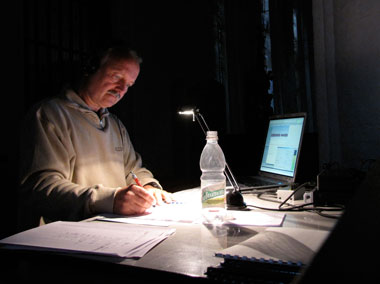
David Lau of Brookwood Studio, Plymouth, Michigan, directed the recording, editing and mastering of this series. Christian Cerny of Leipzig, Germany, served as on-site recording technician throughout the series. The website was produced by the Internet Publication Task Force and Block M Records of the University of Michigan School of Music, Theatre & Dance. |
Privacy Policy
Contact Webmaster: music.webmaster@umich.edu
Copyright © 2010 The Regents of the University of Michigan